

New Data at SCCT 2026 Reinforce Heartflow Plaque Analysis as the Standard for AI-Powered Coronary Artery Disease Management
Heartflow Plaque StagingTM, the only staging tool based on total plaque volume*, is now included with every Heartflow Plaque Analysis
Data from over 36,000 patients validate the accuracy, reproducibility and utility of Heartflow Plaque Analysis
SAN FRANCISCO, July 09, 2026 (GLOBE NEWSWIRE) -- Heartflow, Inc. (Heartflow) (Nasdaq: HTFL), the leader in AI technology for coronary artery disease (CAD), today announced eight new datasets from clinical studies spanning more than 36,000 patients will be presented at the Society of Cardiovascular Computed Tomography (SCCT) 2026 Annual Scientific Meeting taking place July 9-12, 2026 in San Diego.
These studies reveal over 50% of symptomatic patients with zero coronary artery calcium (CAC) harbor significant non-calcified plaque that traditional CAC scoring cannot detect. This underscores a serious diagnostic gap in accurately risk stratifying patients to impact their clinical outcomes. Heartflow Plaque Analysis with Heartflow Plaque Staging closes this gap. The new data show Heartflow’s technology comprehensively reclassifies risk, is highly reproducible, and remains consistent across scanner types— making Heartflow the trusted standard in AI-powered coronary plaque analysis.
Building on this evidence, Heartflow announced the launch of Heartflow Plaque Staging, the only CAD staging tool based on total plaque volume (TPV), integrated into every Heartflow Plaque Analysis. Heartflow Plaque Staging is backed by the strongest data with up to 16 years of follow-up and prospectively demonstrated clinical utility.1,2,3 Every case now includes a Heartflow Plaque Stage—from mild to extensive—based on TPV. Plaque Stages generate automatically in the Heartflow One platform’s User Interface and Structured Report, enabling seamless integration into existing clinician workflows. This allows clinicians to precisely risk stratify patients and confidently manage their care without delay.
“These data underscore why Heartflow Plaque Analysis is the standard for reliable AI-powered coronary plaque analysis,” said Campbell Rogers, M.D., F.A.C.C., Chief Medical Officer at Heartflow. “Clinicians need confidence that a plaque measurement shift reflects true disease progression, not analytical variation. Our studies show total plaque volume-based staging is both reproducible and consistent across scanner types, giving physicians the insights they need for longitudinal disease tracking and evidence-based treatment decisions.”
Key presentations include:
DECIDE Registry (Poster 604): Heartflow Plaque Staging Reclassifies Risk Missed by Traditional Calcium Scoring
Saturday, July 11, 10:55-11:40 a.m.
Symptomatic patients with zero CAC scores can remain at substantial risk from non-calcified (soft) plaque that calcium scoring cannot detect. This DECIDE Registry sub-study of 11,792 symptomatic patients quantifies this diagnostic challenge and demonstrates how TPV-based Heartflow Plaque Staging delivers a precise solution.
- Half of all patients presenting with a CAC score of zero, traditionally considered “zero risk,” were reclassified into higher-risk categories once TPV was considered, confirming the presence of non-calcified plaque missed by calcium scoring alone.
- 30% of patients with CAC scores of 1-99 or 100-299 were moved to a higher-risk category with the addition of TPV, indicating more significant plaque burden.
- The study also demonstrated downward classification in patients with high calcium but more modest TPV, including downward classification in 27% of patients with CAC scores of 1,000 or higher. Results showed that male patients exhibited more upward reclassification, and female patients exhibited more downward reclassification, across all CAC scores.
These data reinforce previously published findings that Heartflow Plaque Staging changed management in more than 50% of patients.4 This latest analysis provides a model for intensifying preventive therapy in patients with high TPV despite zero calcium and for de-escalating in patients with high calcium but lower TPV, demonstrating the value of characterizing both calcified and non-calcified disease burden.
“While coronary calcium scoring has been a helpful foundational tool, relying on calcium scoring alone leaves a diagnostic gap for clinicians, particularly regarding high-risk non-calcified plaque,” said study investigator Vincent L. Sorrell, M.D., the immediate past Chief of the Division of Cardiovascular Medicine and Co-Director of Cardiovascular Research Priority Area at the Gill Heart & Vascular Institute at University of Kentucky HealthCare. “The DECIDE data demonstrate that Heartflow’s TPV-based staging unmasks important cardiovascular disease in over half of symptomatic patients who present with a calcium score of zero. This enhances our ability to accurately identify at-risk individuals and optimize preventive management based on a more precise understanding of their actual disease burden.”
High Precision & Reproducibility (Poster 633): Validating Heartflow Plaque Analysis for Longitudinal Disease Tracking
Saturday, July 11, 10:55-11:40 a.m.
Serial monitoring of CAD only works if measurement variability can be distinguished from true disease change. This study shows Heartflow Plaque Analysis meets this requirement, with minimal inter- and intra-observer variability in a blinded, prospective study—delivering the reproducibility clinicians need for longitudinal tracking with confidence.
The study analyzed 27 coronary computed tomography angiography (CTA) scans, which were blinded and evaluated three times each by three certified analysts, providing 243 independent analyses in total.
- The study demonstrated minimal relative variability between different qualified analysts, with coefficients of variation of 3% for TPV, 6% for calcified plaque, and 4% for non-calcified plaque.
- Repeat analyses by the same qualified analyst proved highly consistent, with variation rates of 5% for TPV, 6% for calcified plaque, and 6% for non-calcified plaque.
- The Fleiss’ kappa score for categorizing patients into TPV-based plaque stages was 95%. This level of agreement establishes the technology as highly reliable for clinical-trial-grade serial monitoring and future tracking of disease progression over time.
Real-World Scanner Transition (Poster 618): Analytical Consistency Across Conventional and Photon-Counting CT
Saturday, July 11, 10:55-11:40 a.m.
As healthcare facilities transition from conventional Energy-Integrating Detector (EID) CT systems to next-generation Photon-Counting CT (PCCT), maintaining analytical consistency is critical for clinical continuity. This retrospective, multi-center study of 12,269 patients across eight clinical sites directly tested whether Heartflow's plaque quantification, stenosis grading, and FFRCT values remain consistent across this scanner technology transition.
Results showed no significant differences between EID and PCCT for TPV, non-calcified plaque, calcified plaque, maximum stenosis grade, lowest FFRCT value and anatomy-physiology reclassification rates. The findings demonstrate that clinical sites transitioning to next-generation PCCT can ensure comparisons using Heartflow Plaque Analysis remain valid during scanner transitions.
Together, these findings show why Heartflow Plaque Analysis is setting the standard in AI-powered CAD management: delivering Plaque Staging that comprehensively reclassifies risk, reproducible results over time, and consistency that holds across scanners.
Experience Heartflow Plaque Staging at SCCT 2026
SCCT 2026 attendees are invited to visit the Heartflow exhibit booth (Booth #101) for live demonstrations of Heartflow Plaque Staging. Attendees can observe firsthand how the workflow translates complex plaque data into actionable insights. See the full schedule of other Heartflow programs, including a lunch symposium, product showcase theater, educational reception, and more at event.heartflow.com/scct.
About Heartflow Plaque Analysis with Plaque Staging
Heartflow Plaque Analysis is the only FDA-cleared, AI-powered plaque analysis tool with a reported 95% agreement with the gold standard, intravascular ultrasound (IVUS), in a prospective, international trial using blinded core lab adjudication.5 Heartflow Plaque Staging builds on this foundation, categorizing plaque burden into clinical risk stages based on total plaque volume, enabling clinicians to move from measurement to actionable risk stratification.6,7 The staging framework has been prospectively validated in 23,000 patients with up to 16 years of follow-up, leveraging a highly reproducible analysis suitable for serial disease monitoring and guiding individualized preventive treatment strategies.
About Heartflow’s Technology and Research
Heartflow’s technology is redefining precision cardiovascular care through clinically-proven AI and the world’s largest coronary imaging dataset. Heartflow has been adopted by more than 1,800 institutions globally and continues to strengthen its commercial presence to make this cutting-edge solution more widely available to an increasingly diverse patient population. Backed by American College of Cardiology and American Heart Association (ACC/AHA) guidelines and supported by more than 625 peer-reviewed publications, Heartflow has redefined how clinicians manage care for over 650,000 patients worldwide.8 Key benefits include:
- Unmatched Proprietary data pipeline: Built from the world’s largest database of more than 200 million annotated CTA images, Heartflow’s data foundation powers advanced AI models that deliver highly accurate, reproducible insights across diverse patient populations.
- Extensive clinical and real-world validation: Heartflow’s AI-driven solutions have been validated through clinical evidence in over 200 studies assessing over 365,000 patients. Heartflow is the only AI platform prospectively validated against invasive gold standards and demonstrated through real-world evidence to improve patient outcomes.9,10,11,12 Proven in real-world practice with reproducibility and accuracy, Heartflow’s coronary CTA image acceptance rates exceed 97%.
- Seamless clinical integration via upgraded workflow: Heartflow delivers final quality-reviewed analyses instantly upon order, enabling clinicians to move from diagnosis to decision without delay.
- Quality system, global security and patient-data integrity compliance: Heartflow meets or exceeds leading international standards, including HITRUST, SOC 2 Type 2, ISO 13485, and ISO 27001.
About Heartflow, Inc.
Heartflow is transforming coronary artery disease from the world’s leading cause of death into a condition that can be detected early, diagnosed accurately, and managed for life. The Heartflow One platform uses AI to turn coronary CTA images into personalized 3D models of the heart, providing clinically meaningful, actionable insights into plaque location, volume, and composition and its effect on blood flow — all without invasive procedures. Discover how we’re shaping the future of cardiovascular care at heartflow.com.
Media Contact
Elliot Levy
elevy@heartflow.com
Investor Contact
Nick Laudico
nlaudico@heartflow.com
1 Fairbairn, et al. Presented at AHA Scientific Sessions November 2025.
2 Huck, et al. Presented at ACC 2026.
3 Chandrashekhar et al. 2025. Quantitative Coronary Plaque Analysis in Clinical Practice. 202 ACC Scientific Statement. doi/10.1016/j.jcmg.2025.11.008
4 Rinehart SJ, et al. DECIDE Primary Outcomes. J Cardiovasc Comput Tomogr. 2025; 19(4):S78-79. doi.org/10.1016/j.jcct.2025.05.185
5 Ihdayhid A, et al. Radiol Cardiothorac Imaging. 2024. doi: 10.1148/ryct.230312 and internal bridging study with ICC correlation between first generation and second generation Plaque Analysis algorithm.
6 Rinehart, et al. JACC Imaging. 2025.
7 Fairbairn et al. Coronary CT Angiography Plaque as a Predictor of Death, Cardiovascular Death and Myocardial Infarction. Presented at AHA 2025. (Real-world study with n=7,899 patients, higher TPV results in increased cardiovascular death and MI)
8 Gulati, et al. 2021 AHA/ACC/ASE/CHEST/SAEM/SCCT/SCMR Guideline for the Evaluation & Diagnosis of Chest Pain. J Am Coll Cardiol
9 Narula, et al. E HJ CVI 2024
10 Danad, et al. JAMA Cardiol 2017
11 Fairbairn et al. Coronary CT Angiography Plaque as a Predictor of Death, Cardiovascular Death and Myocardial Infarction. Presented at AHA 2025. (Real-world study with n=7,899 patients, higher TPV results in increased cardiovascular death and MI)
12 Madsen KT, et al. ADVANCE-DK 7-year. Presented at TCT Scientific Sessions 2024 (n=900 patients determined a 2.5x increase in cardiovascular events or deaths at 7 years)
* As of July 2026, Heartflow Plaque Staging is the only tool integrated within a commercially available product.
A photo accompanying this announcement is available at https://www.globenewswire.com/NewsRoom/AttachmentNg/b543e9a9-f827-4ac4-949b-13c5c610fb72.


Risk Stratification Based on TPV, an Independent Predictor of Events
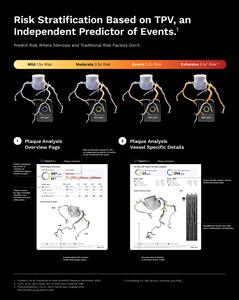
Predict risk where stenosis and traditional risk factors don't.
Legal Disclaimer:
EIN Presswire provides this news content "as is" without warranty of any kind. We do not accept any responsibility or liability for the accuracy, content, images, videos, licenses, completeness, legality, or reliability of the information contained in this article. If you have any complaints or copyright issues related to this article, kindly contact the author above.
